
Drainage guide for Treasure Coast property owners
Why Your Florida Yard Holds Water — and What Actually Fixes It
A lawn that stays soggy for days, a driveway that ruts out every storm, a low corner that never dries. These look like different problems and usually come from the same short list of causes. Identifying yours first is what keeps you from paying for the wrong fix.
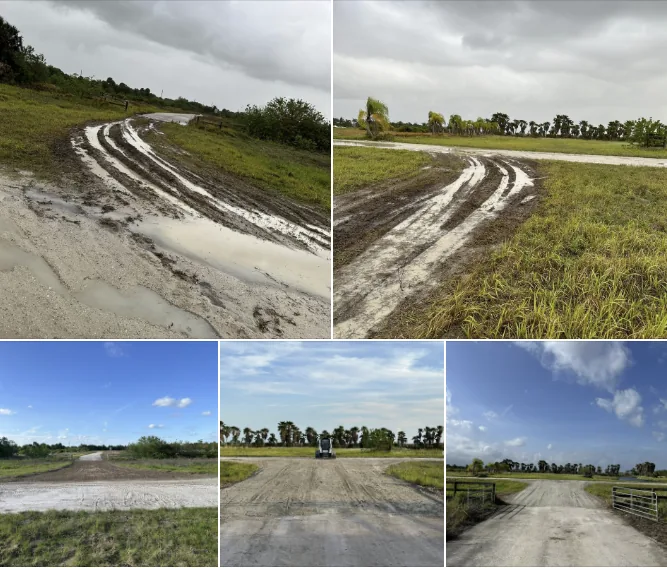
Cause 1: the ground slopes the wrong way
This is the most common one and the most fixable. Water moves downhill, and if the finished grade of your yard falls toward the house, the shed or a corner with no exit, that is where it collects. Settling over time, fill added during a past project, new landscape beds and even a driveway replacement can all change how a yard drains. The test is simple: go outside while it is raining hard and watch where the water goes. That single observation is worth more than any measurement taken on a dry day.
Cause 2: the low spot has nowhere to drain
Some yards slope correctly and still hold water, because the water arrives somewhere with no outlet. A fenced back corner, an area enclosed by a raised driveway and a neighbor's berm, or a depression left behind after a tree was removed will fill and then sit there until it evaporates or soaks in. Fixing the slope inside that area does nothing on its own. The water needs somewhere legal and practical to go — a swale, a drain line, a connection toward an existing ditch — before reshaping matters.
Cause 3: the outlet is blocked or silted in
Swales fill with grass clippings and sediment. Driveway culverts silt up, crush, or get buried under added fill. Roadside ditches get regraded. If your yard used to drain and now does not, and nothing else changed, look at the path water used to take out of the property. Restoring an outlet that already exists is usually far less work than building a new drainage system.
Cause 4: the water table is simply high
This one is not a defect. Much of the Treasure Coast sits on sandy soil over a seasonally high water table. After a heavy wet stretch, the ground can be saturated from below, and surface water has nowhere to soak away because the soil is already full. Grading and drainage help the water leave faster, but no amount of earthwork will make a yard drain during a week when the water table is at the surface. Anyone promising otherwise is selling you something.
What grading actually does
Grading reshapes the surface so water moves in a chosen direction at a controlled slope. Done properly it means cutting the high areas, filling the low ones, compacting so the result does not settle back, and establishing a consistent fall away from structures and toward an outlet. It is the least glamorous drainage fix and very often the correct one, because it solves the problem with dirt rather than with pipe that can clog.
When you need drainage structures instead
When there is no workable path for surface water to leave, or when the water has to cross under something, structures come into it. A swale carries water along a shaped channel. A French drain collects water below the surface and moves it to a discharge point. A culvert carries a ditch line under a driveway so the flow is not interrupted. Each one only works if the water has an actual destination — a drain that discharges into another low spot has just moved the puddle.
Why driveways wash out, and why patching never holds
A driveway that ruts out after every storm is a drainage symptom. Water is running along the driveway instead of across and off it, and once a rut starts, it channels more water and deepens faster. Adding rock to the ruts fixes the appearance for a few weeks. The durable repair reshapes the surface with a crown or a consistent cross-slope so water sheets off the sides, makes sure the sides can accept it, and rebuilds the base with material that compacts and stays put.
Do not just push the water next door
Drainage work has neighbors. Concentrating runoff and discharging it onto an adjacent property, or into a system not designed to take it, causes problems and can create liability. A legitimate drainage plan identifies where the water is allowed to go before it decides how to get it there. If a contractor's answer to 'where does this discharge?' is a shrug toward the property line, get another opinion.
Common questions
Will French drains fix my standing water?
Only if there is somewhere for the collected water to discharge to, and only if the problem is surface water rather than a saturated water table. A French drain installed in a yard with no outlet and high groundwater fills up and stops working. Diagnose the cause before choosing the fix.
Is regrading or a drainage system the cheaper fix?
Regrading is usually less expensive when the yard has a usable direction to drain toward, because it is dirt work rather than materials and installation. When there is no outlet, structures are the only option and the comparison does not apply.
How long does the ground need to dry before you can work?
It depends on how saturated the soil is and how heavy the equipment needs to be. Working saturated ground causes rutting and compaction damage that has to be repaired afterwards, so waiting a few days after a wet stretch often produces a better result for the same money.
Can you fix drainage around a new patio or driveway?
Yes, and it is better to plan it with the surface rather than after it. Any new hard surface changes where rainwater goes, so the slope, edges and any drains around it should be designed alongside the layout.
Keep reading
Published September 21, 2026 · Onshore Horizons LLC · Serving Sebastian to Hobe Sound