
Cost guide for Treasure Coast property owners
What Land Clearing Actually Costs on the Treasure Coast
Search for land clearing prices and you will find per-acre numbers from all over the country. They are close to useless for a specific lot in Port St. Lucie or Vero Beach. Here is what a real estimate is built from, and how to get one that you can compare.
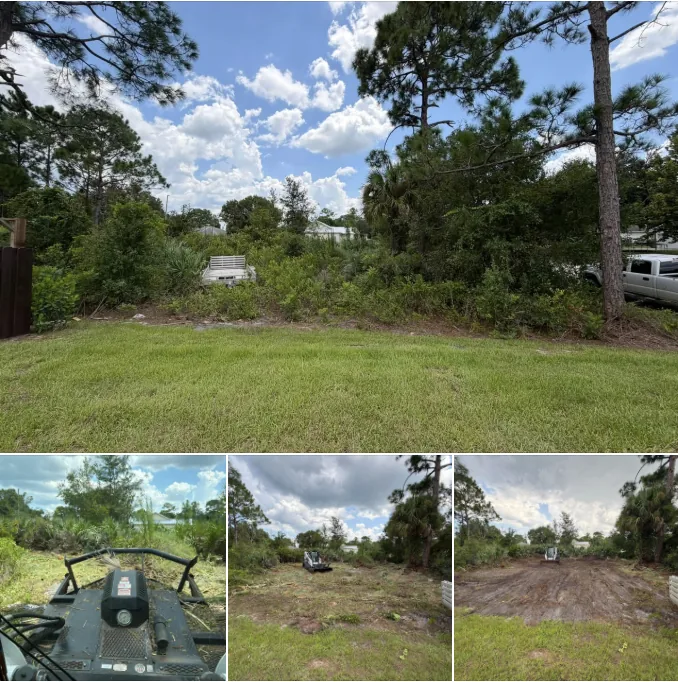
Why per-acre pricing falls apart on a real lot
A per-acre figure assumes every acre contains the same material and the same obstacles. On the Treasure Coast that is rarely true. One acre of light Brazilian pepper and palmetto is a different machine, a different number of hours and a different disposal bill than one acre holding mature oaks, buried stumps and a fence line running through the middle of it. Per-acre averages are a useful sanity check on a large, uniform parcel. On a half-acre residential lot they mostly tell you what somebody else paid for a different job.
1. How dense the vegetation is
Density is the biggest single factor. Knee-high brush and light undergrowth can be cut and cleared relatively quickly. Heavy palmetto, thick vines, stacked years of overgrowth and mature trees all slow the work down and produce far more material to deal with. When you send photos, include one wide shot that shows how thick the growth actually is, not just the edge of it from the road.
2. What has to come out of the ground
Cutting vegetation at the surface and removing the root systems are two different jobs. Stumps, root balls and buried debris take time and put more strain on the equipment. If the ground has to be usable for building, paving or sod afterwards, the roots usually have to go. If the goal is simply to open up a wooded area so you can walk and see through it, they often do not. Being clear about this one point changes the price more than almost anything else you can tell us.
3. Where the material goes
Cleared material does not disappear. It is hauled off to a disposal site, mulched and spread on the property, or piled somewhere out of the way. Hauling costs the most because it adds trips, trailer time and disposal fees charged by weight and material type. Mulching on site is often cheaper and keeps the organic material on your land. Piling is cheapest up front and leaves you with a pile. All three are legitimate choices, and the estimate should state which one it assumes.
4. How equipment reaches the work
Access is the factor property owners most often forget to mention and the one most likely to change a quote after a site visit. A narrow gate, a soft or boggy approach, a septic field or drain field in the path, overhead lines, a neighbor's fence, or a work area reachable only through a finished lawn all affect the equipment we bring and how carefully it has to move. Photograph the route from the street to the work area and mention the width of the narrowest point.
5. How finished the ground needs to be
Cleared and graded are not the same thing. Clearing removes what is growing. Grading reshapes the dirt underneath into a planned surface with a slope that sheds water. A lot that will sit until next year needs less finish work than one that has sod going down next month or a driveway base going in. Decide what happens next on that ground and say so, because it determines whether grading, fill or compaction belongs in the scope.
6. Site conditions on the day
Florida weather is part of the price. Saturated ground after a wet stretch means heavier work, more rutting to repair and sometimes a delay. Standing water can make an otherwise routine job impractical until it drains. This does not usually change a written estimate, but it does affect scheduling, and it is worth mentioning if the area you want cleared stays wet.
Permits and protected trees
Clearing rules on the Treasure Coast are set locally. Cities and counties in this area commonly regulate the removal of protected or specimen trees and clearing on undeveloped parcels, and requirements differ between Port St. Lucie, Fort Pierce, the unincorporated county, Vero Beach and Sebastian. Before work is scheduled, confirm with your local building or planning department what applies to your parcel and what you are removing. Tell us what they require and the scope gets written to match your approval, rather than being discovered halfway through.
How to compare two clearing quotes
Put the two estimates side by side and check five things before you look at the totals: what material is being removed, whether stumps and roots are included, where the debris ends up, whether any grading is included, and what the ground is expected to look like when the crew leaves. Two quotes that both say 'land clearing' can describe very different amounts of work. The cheaper one is often cheaper because it stops sooner.
Common questions
Is land clearing cheaper per acre on a larger property?
Often, yes. Mobilization, equipment transport and setup are close to fixed costs, so spreading them across a larger job lowers the effective per-acre figure. That only holds when the larger area is similar throughout. A big parcel with a dense, difficult back section does not average out the way the math suggests.
Does clearing include grading the lot?
Not automatically. Clearing removes vegetation; grading reshapes the ground afterwards. They are frequently quoted together because most people want usable ground rather than a stripped lot, but confirm which one your estimate covers.
Can you give a price over the phone?
For a straightforward job with good photos, often yes. For anything with access problems, large trees, drainage questions or an uncertain finish, a short site visit produces a number you can rely on instead of one that changes later.
Keep reading
Published September 21, 2026 · Onshore Horizons LLC · Serving Sebastian to Hobe Sound