
Preparation checklist for Treasure Coast lots
How to Prepare Your Lot Before the Clearing Crew Arrives
Most clearing jobs that go sideways do so for the same reasons: something got removed that was meant to stay, something buried got hit, or the equipment could not reach the work. All three are avoidable in about ten minutes of preparation.
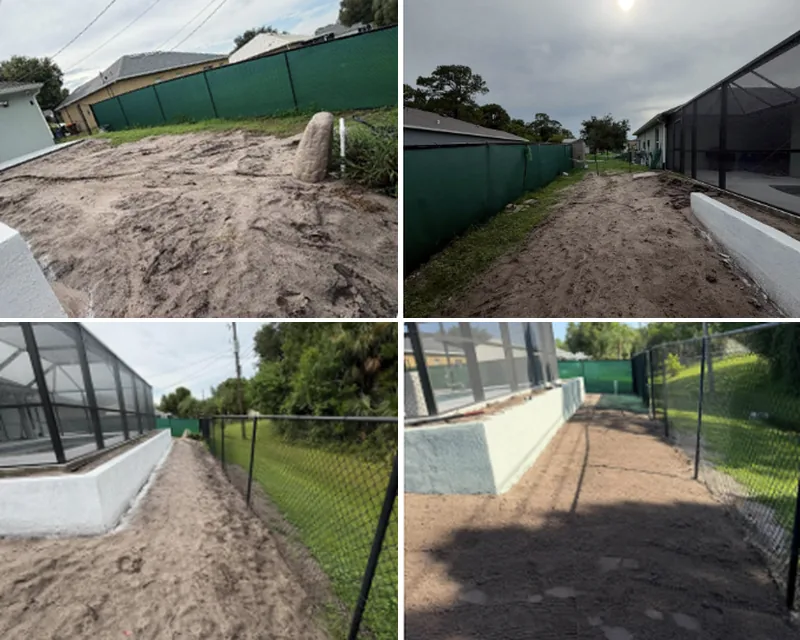
Mark what stays before anyone quotes the job
Walk the property and physically mark every tree, shrub, planting or feature you want to keep. Flagging tape, spray paint or stakes all work. Do this before the estimate, not on the morning of the work, because what stays changes how the equipment moves through the site and therefore what the job costs. A tree in the middle of an area to be cleared is not the same as one at the edge. If you are unsure whether something is worth keeping, mark it anyway — removing it later is easy, putting it back is not.
Find out what is buried
Buried public utilities need to be located before any digging, and Florida's free 811 service marks them. That service does not cover what you installed yourself. Irrigation lines and heads, landscape lighting, pool plumbing and electric, propane lines, septic tanks and drain fields, well lines, invisible fencing and buried downspout drains are all yours to point out. Sketch them on a photo if you know roughly where they run. A drain field is the expensive one — mark its footprint clearly, because equipment driving across it can damage it.
Check access from the street to the work
Measure the narrowest point equipment has to pass through, usually a gate or the side yard between a house and a fence. Note anything overhead: power drops to the house, low branches, carport edges. Note anything soft: a boggy stretch, a septic field, a newly sodded area you do not want tracked across. If the only route runs through finished lawn, say so — it is workable, but it changes how carefully the machine moves and what protection is needed.
Decide where the material ends up
This is the single biggest cost lever on most clearing jobs, and it is entirely your call. Hauled off and disposed of is the cleanest and the most expensive. Mulched and spread keeps the organic material on your property and usually costs less. Piled in a back corner is cheapest and leaves you with a pile to deal with eventually. There is no wrong answer, but decide before the estimate so the number reflects the choice.
Confirm permits and tree rules for your parcel
Rules differ between Port St. Lucie, Fort Pierce, unincorporated St. Lucie County, Vero Beach, Sebastian and Martin County, and they commonly cover protected or specimen trees and clearing on undeveloped parcels. Call your local building or planning department, describe the parcel and what is being removed, and ask what applies. Do this early. A permit question discovered on the morning of the job stops the job.
Say what the ground is for next
Clearing for a lot that will sit for a year is different work from clearing for sod going down next month or a driveway base going in. If the ground has a next use, the finish grade, the stump and root removal and the compaction all need to account for it. Telling us the plan is often what prevents a second mobilization later to do work that could have been done the first time.
Move what you can move
Vehicles, trailers, equipment, hoses, yard furniture, garbage bins and anything stored along the route or in the work area should be out of the way before the crew arrives. It is a small thing that prevents lost time and accidental damage. If there is something heavy you cannot move yourself, mention it ahead of time rather than on the day.
Tell the neighbors, if the property line is close
When the work runs along a shared fence line, a heads-up avoids a bad conversation mid-job. It also flushes out the useful information: a neighbor who knows an irrigation line crosses the line there, or that the fence is theirs and not yours, or that they have been meaning to clear their side too.
Common questions
Do I need to be home while the lot is cleared?
Not usually, as long as what stays and what goes was settled in writing beforehand and access is available. For a first job together, being there for the first thirty minutes is worth it — that is when any remaining ambiguity gets resolved.
How long does clearing a residential lot take?
It depends on the area, the density of the growth, whether stumps come out and where the debris goes. Your estimate should include the expected duration for your specific property; a general figure for a lot you have not seen is not worth much.
What happens if something unexpected turns up mid-job?
Buried debris, an old foundation, a septic component nobody knew about or an unmarked line does occasionally surface. The work stops on that area and you get a call before anything changes. Nothing outside the agreed scope gets done without your say-so.
Can you clear right up to the property line?
Up to the line on your side, yes, assuming the line is known and the equipment can work there safely. Confirm where the boundary actually runs before work starts — a fence is not always on the line — and be aware that trees on or across a boundary may have their own rules.
Keep reading
Published September 21, 2026 · Onshore Horizons LLC · Serving Sebastian to Hobe Sound